

As a sleep consultant, I'm often asked: Won't it cause problems that my baby clings to me all day and only falls asleep in a baby carrier? Am I not spoiling them? Am I ruining them by constantly holding them and having to walk around with them? But I can't even put them down to sleep in their crib, where they are supposed to be!
How do babies sleep before they are born?
I like to go back in my explanation to where we don't have any influence yet: let's see what happens to the baby in the womb. How do babies sleep before they are born? How much do they sleep?
95–98 percent of the day. Yes, you heard that right! Almost continuously!
“Mine definitely didn't sleep that much, they were kicking constantly, especially at night! That must be why they're such a bad sleeper,” you might say. That's because babies move at least 50 times an hour in the womb. Yes, you heard that right: it means they move even while sleeping! Continuously! And meanwhile, you are moving too! Even at night. Do you see now why it's completely natural that they need to be carried all the time and won't sleep a single minute in the crib?
Babies' sleep and skin-to-skin contact

And I haven't even mentioned touch yet, since in the womb you are constantly touching, “hugging” your baby. What's more, they hear your sounds, the pulsation of the umbilical cord just like your heartbeat. Is it any wonder they don't want to sleep in silence in a separate room in a crib? No wonder at all. 🙂
Sorry, but you already “spoiled” them in the womb!
So continuous movement, physical closeness, and touch are basic needs for a baby.
There is a very illustrative series of studies that proves this strikingly.
You've probably heard of Harlow's rhesus monkey experiment, often called the “cloth mother” experiment: infant rhesus monkeys were separated from their mothers at birth and raised in a cage. There were two objects in the cage: a “cloth mother,” which was a dummy covered in soft fabric, and another dummy, a “wire mother,” which only provided milk from a bottle. The researchers observed that the baby monkeys spent far more time on the “cloth mother” than on the “wire mother.” Even though the food—the milk—came from the latter. From this, we learned that affection—clinging to the mother—is more important than food itself.
However, few people know that these little monkeys did not grow up to be healthy at all (they developed an aversion to touch, became aggressive, lacked social skills, couldn't get pregnant, and if they did, became neglectful mothers) (Harlow and Harlow 1981). So this alone wasn't enough; something was missing.
Mason and colleagues took the experiment further: their idea was to change just one single thing: they suspended the “cloth mother” in the cage from an elastic band—so when the baby monkeys climbed onto it, it began to rock up and down and side to side. And lo and behold! This way, they developed into healthy monkeys (Mason 1968).
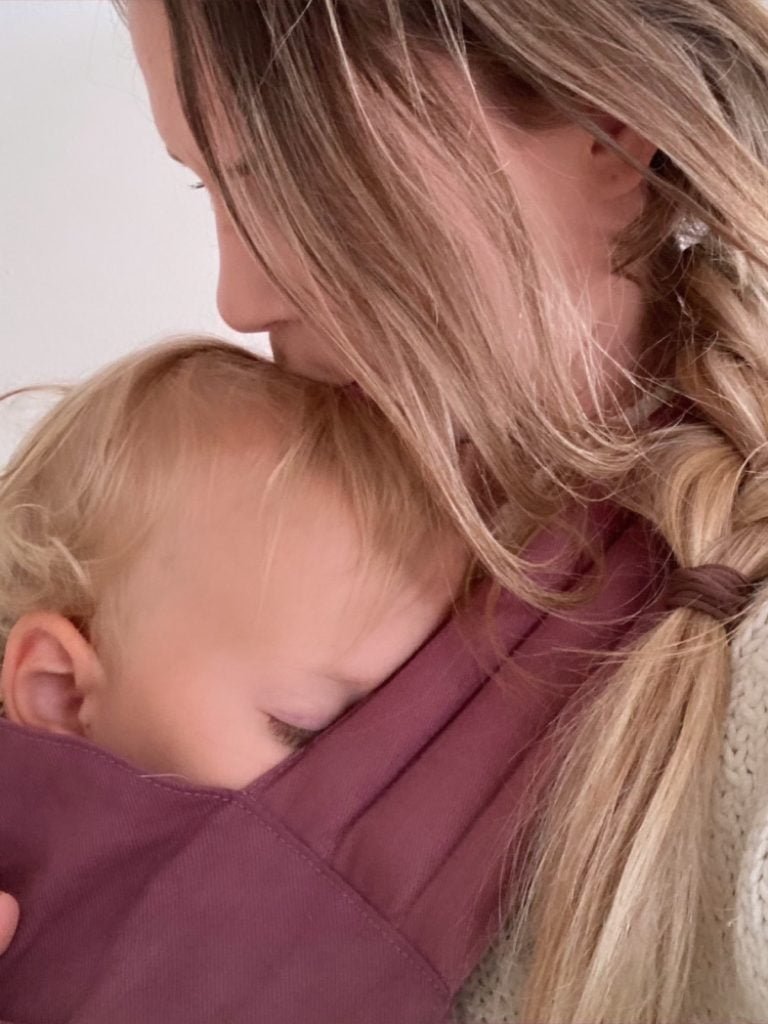
So every time you don't manage to put your baby down for sleep and you're logging miles walking with the baby carrier, think about what wonderful work you are doing right then: you are nurturing your baby's development so they can grow up healthy!

Szandi Kalmár – The Author
I remember when my daughter was about 6 months old and I picked up Liedloff's book, The Continuum Concept (In Search of Lost Happiness). I immediately felt that this was probably the only book worth reading about parenting a baby. Right away, I wrapped Lili onto me using the wrap that had been tucked away deep in the closet. Suddenly, all my doubts about whether I could properly wrap her into that piece of fabric vanished. And that's how it all began…
From then on, there were no questions—or at least not as many, and not as painful. Because I could listen to my heart and my intuition. People around me still managed to make me doubt myself from time to time, saying it wasn't good that the baby was constantly „hanging” on me, and questioning what kind of experiment I was running by raising her this way. Then, when I started studying the topic more formally—sleep, breastfeeding, babywearing—all doubts completely vanished, and I was able to weather the storms with confidence. I have been striving to pass this confidence on to the mothers who turn to me ever since. My children are now 11.5 and 16 years old, but I still look back with great nostalgia at those first years, which I could have navigated so much more easily with more information and support.
If you feel stuck and need help, feel free to reach out to Szandi!